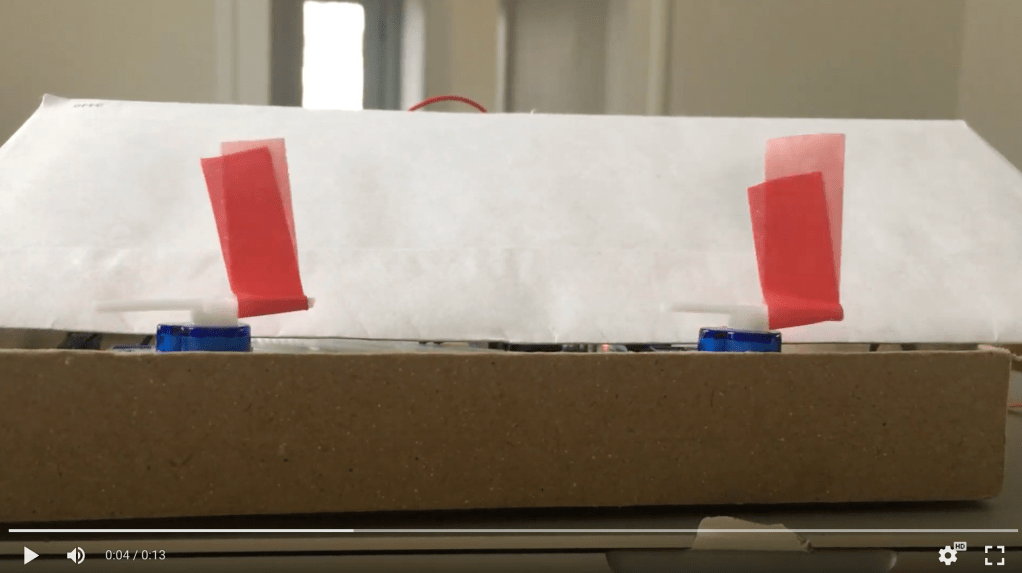
servo motors programmed for 2 on 3
Polyrhythms are African rhythms in which we play two different meters that meet up on the one. For example, in “2 on 3” we would subdivide a beat into three sections in our right hand and into two sections in our left. In western music we call this “two against three” but I like to think about it more like “when two syncs up with three, then go their separate ways, then syncs up again.” It’s a beautiful thing. We can be in our own group with our own take on the beat, yet we agree on setting a regular time to come together. And that whole thing creates a pattern that is beautiful and complex. Percussionist and Educator Babatunde Lea extends this metaphor to culture and goes deep:
“I.. ask [my students] to play the first rhythm with their right hand while simultaneously playing rhythm number two with the left hand, independently. I ask them to try starting with the right hand, then starting with the left hand. They all struggle, and fail. I then slow the process way down and just take several at a time (notes in the bar). I show them where their hands fall together and hit separately. After several attempts, some of them get better. I ask them: “Was that difficult?” They reply, overwhelmingly, “Yes.” I pursue this line of inquiry: “But was it getting easier?” “Yes.” “And with practice do you think you could master it? A little less certainty, but most of the students, volunteer a third, “Yes.”
“After a short break and a little deep breathing, I turn from music to words and metaphor. I describe the complex rhythms the students have tried to play: they are polyrhythms. I tell the students that to many people, those who have not studied the drums, the rhythms sound impossible to understand. This is an illusion because with lessons and study one can begin to understand. From the first experience in the womb, all human beings are exposed to polyrhythms. However, we are born into many varied cultural worlds with different cultural rhythms. Polyrhythms are intricately woven patterns, meeting at a central point called the “One.” The “One” is the place at which the rhythms begin and intersect. The students appear to understand. I validate that finding the “One,” as we have tried to do, is hard but if you want to find it enough, it can be found. It takes a concerted effort and motivation. It takes will and commitment.
“That, of course, is the point of the activity. “Polyrhythms” can be seen as a metaphor for culture. In a pluralistic society like the United States, many cultures are arranged hierarchically, interrelating, jostling for recognition and space.The influence that one culture has on another can be documented. Finding out where these disparate cultures connect (like a polyrhythm) is an art. However, if we want to move toward a better understanding of social equity, we must find the “One” – the place at which different cultural expressions intersect.
“While searching for the “one,” we must develop a critique along the way so that we can understand when and why our efforts fail. Some of the rhythms, because of their innate differences are deemed more complicated and more powerful than others. This is an illusion that we must begin to see through. If there is any aspect of a polyrhythm that is wrong, then the whole rhythm is set askew. All must learn to understand and respect the other rhythmic components and their importance to the polyrhythm as a whole. It is finally driven home to my students that there exist road blocks that are physical, emotional, intellectual, cultural, economic, and political that will stop us from understanding the polyrhythms of culture. However, with the aforementioned, concerted will, we can come to a greater understanding and appreciation of any given cultural form. We must resist the forces that would have us find an easier way hence, allowing us to reproduce inequities. We must develop agency.“
Whoa.
This is a title and section is from a book chapter written by BABATUNDE LEA, VIRGINIA LEA in Counterpoints, Vol. 321, Undoing Whiteness in the Classroom: Critical educultural teaching approaches for social justice activism (2008)
 TUNING Design Co.